Tevis Engineering Solutions Tevis EngineeringSolutions
TES Software · Free to try

Instant Roof Estimates, On Your Own Site

A homeowner types their address. The roof is measured from aerial survey data — real area, real pitch, nothing to draw — and they see a price band built from your rate card. The lead lands in your inbox with the measurement already done.

Try it on a real address, free, further down this page. No signup, no card, nothing to install — the same estimator, running live.

How it works

Four steps. The homeowner is done in about a minute; you are done when you pick up the phone.

They type an address

On your site, in your branding.

The roof gets measured

Survey data returns pitch-corrected area, the measured pitch, and the plane count.

Three questions

Material, stories, and layers — the things no aerial can answer.

Band, then booking

A price range, an honest caveat, and their details in your inbox.
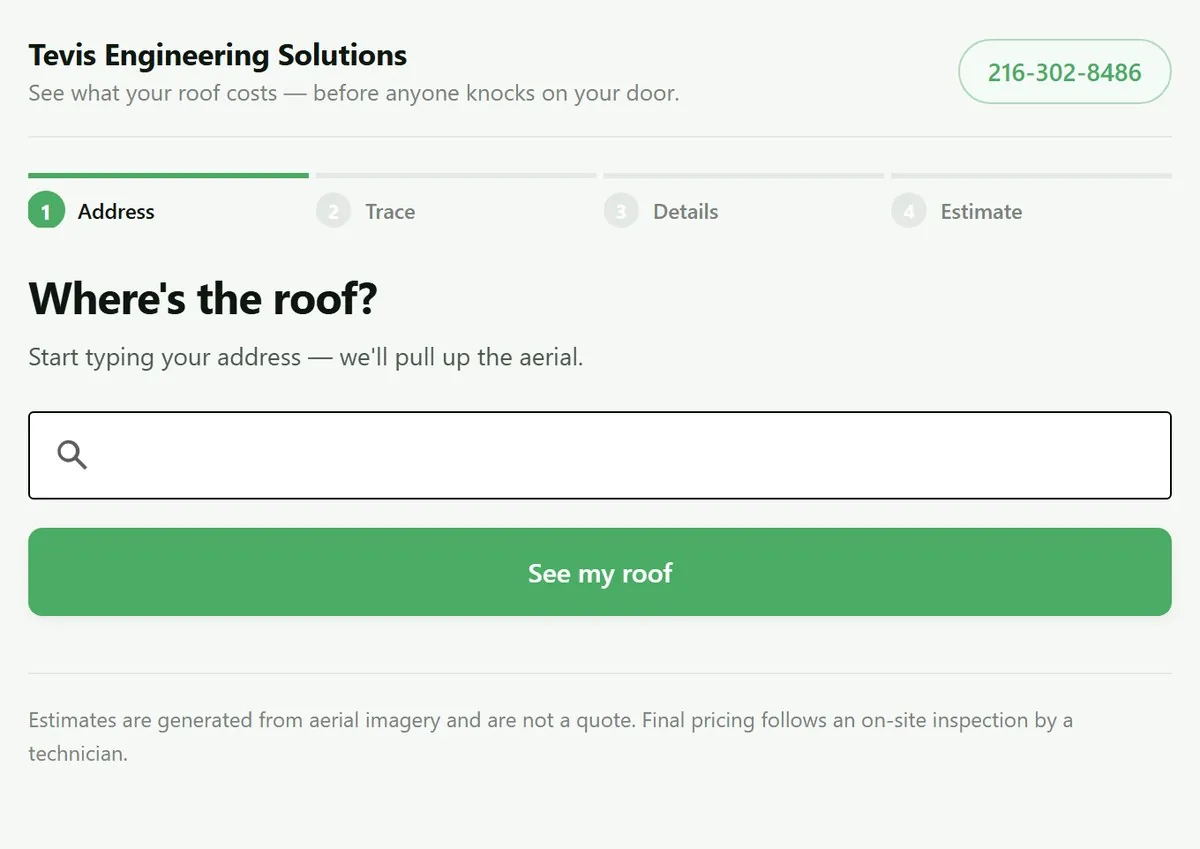
The first step of the ShingleAI estimator: a branded header with the contractor's name, tagline and phone number, a four-step progress bar, and an address box headed Where's the roof?
Step 1Your name on the front door. Your logo, colors, and phone number — the software never asks for the spotlight.
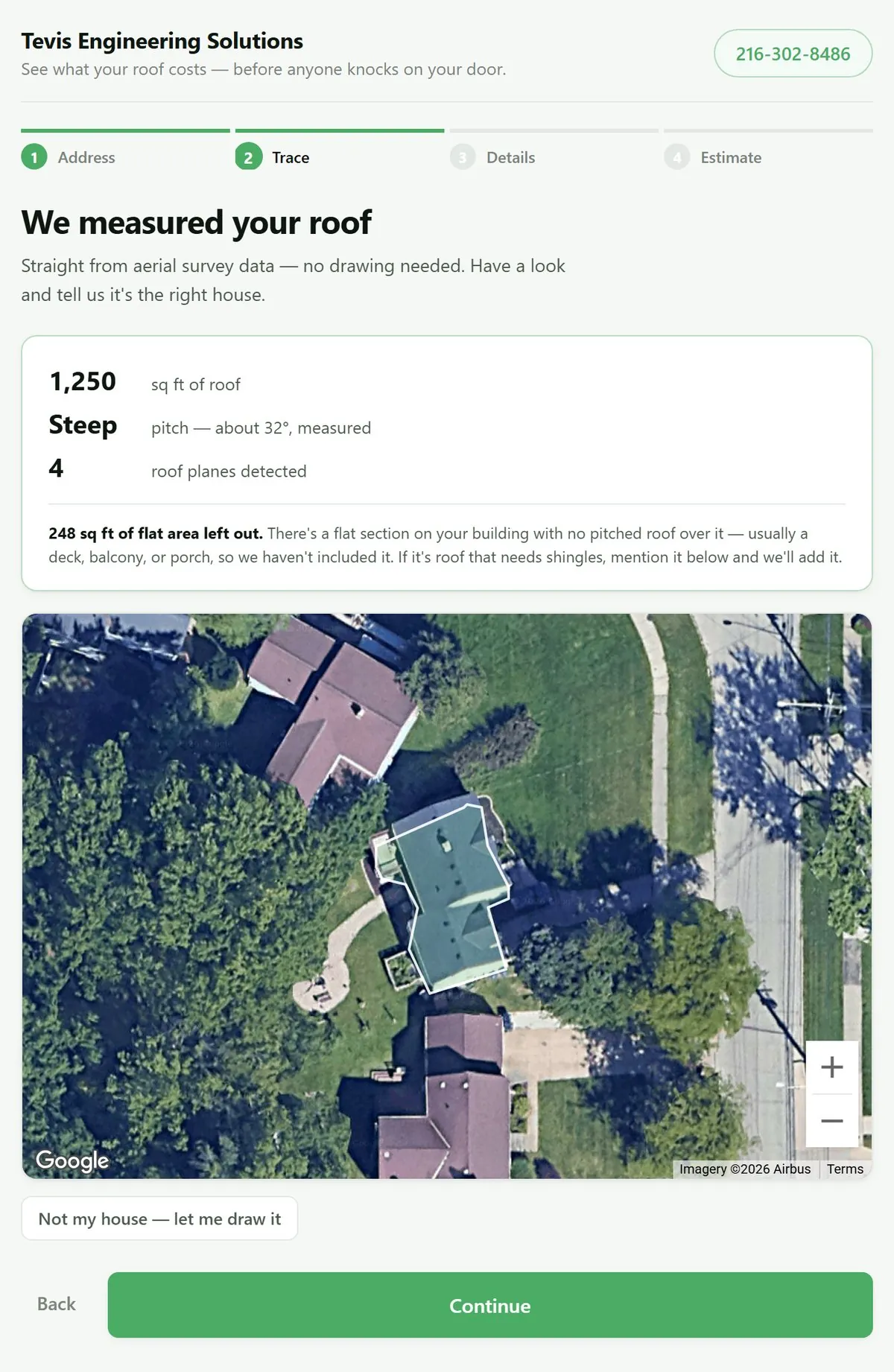
The ShingleAI estimator on the Trace step: a card reading 1,250 sq ft of roof, steep pitch measured at about 32 degrees, and 4 roof planes detected, above a satellite view with the roof outline drawn on the house.
Step 2Measured, not guessed. Area, pitch, and plane count from the survey, with the outline drawn on the aerial. They confirm it is their house.
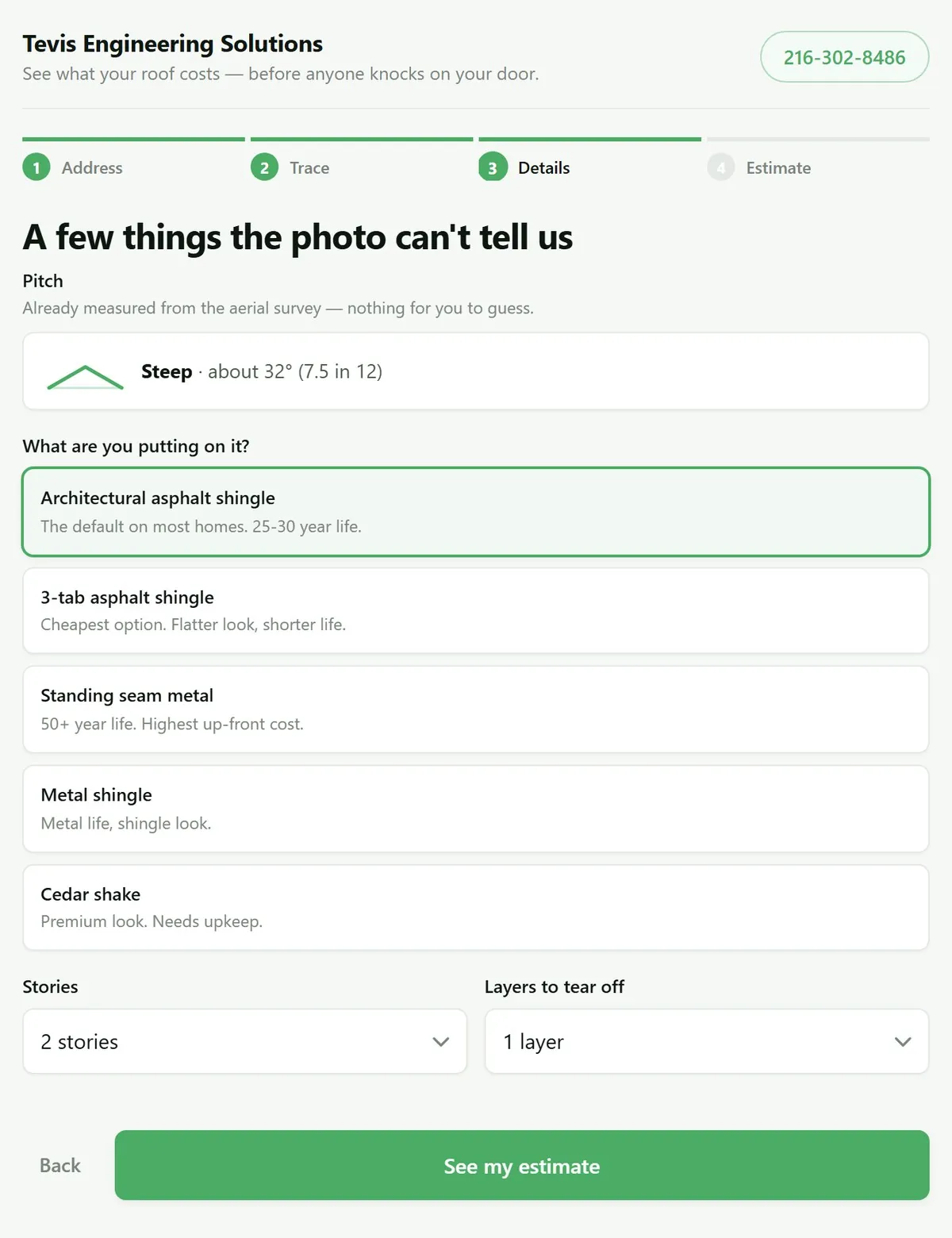
The Details step of the ShingleAI estimator: the measured pitch shown as steep at about 32 degrees, a list of material choices with plain-English descriptions, and dropdowns for stories and layers to tear off.
Step 3Only what the photo can't tell you. Material, stories, and existing layers, with the measured pitch already filled in.
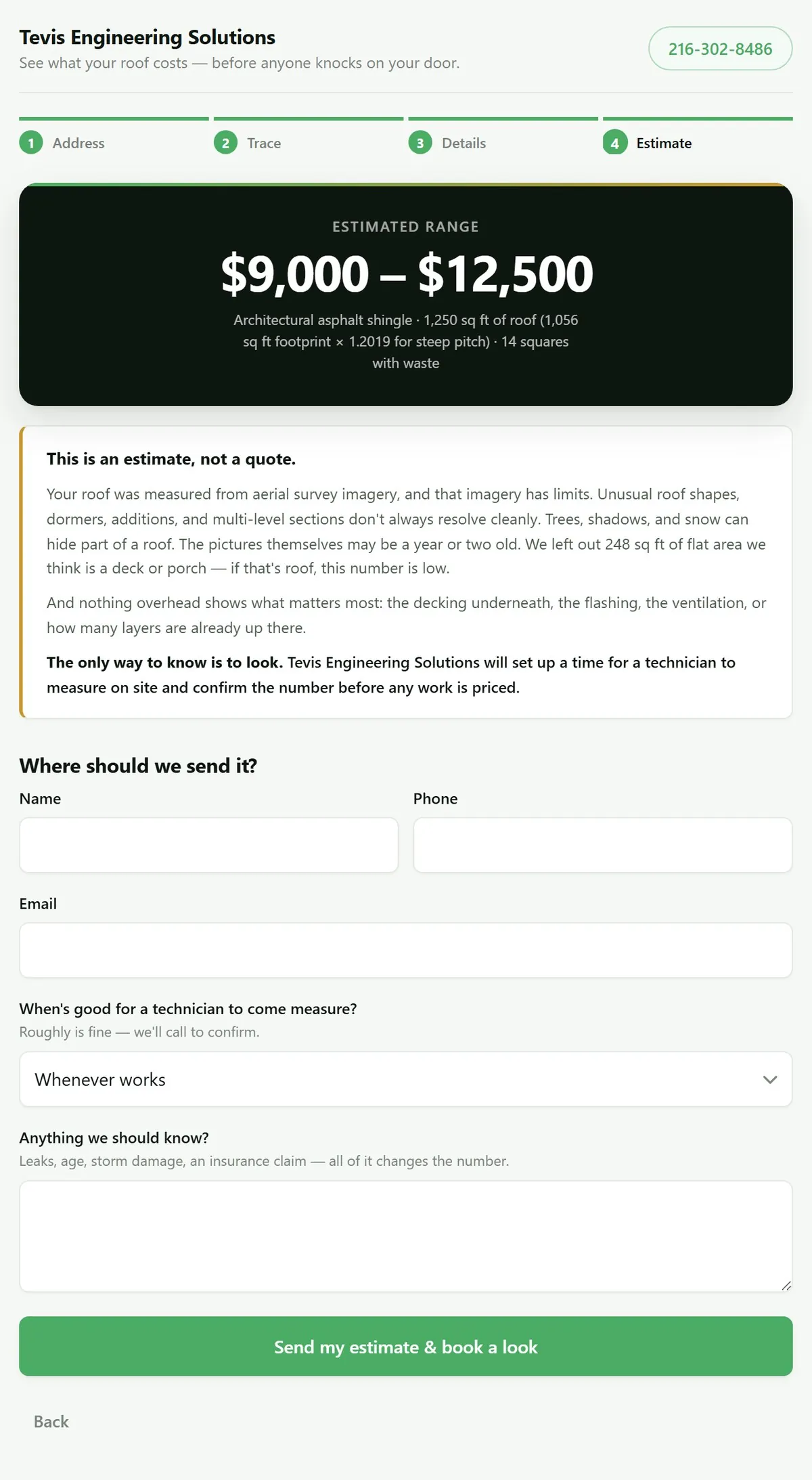
The ShingleAI estimator on the Estimate step: an estimated range of 9,000 to 12,500 dollars with the material and square-footage math beneath it, a plain-English accuracy notice, and a short contact form to send the estimate and book a technician.
Step 4A number, a caveat, a booked look. The band, the math behind it, and one short form — which is where your lead comes from.

Pitch correction built in

An aerial shows a footprint, not a roof. A 6/12 roof is 11.8% bigger than its footprint; a 12/12 is 41.4% bigger. Every estimate applies that, then waste, tear-off per layer, and adders for pitch and height.

Your rate card stays private

The page sends geometry to the server; the server sends back dollars. Your rates never reach the browser, and the estimator only runs on domains you own.

A lead you can act on

Not just a name. The contact, the measurement, your own cost breakdown on that roof, the aerial, and a suggested reply you can send from the truck.

The lead is yours alone

It came from your website, not a marketplace. Nobody else is called about it, and the first conversation starts at “when can you come measure it” instead of “what do you charge.”

Try it — on a real address

This is the estimator running live, not a video. Type any US address and it will measure that roof from aerial survey data and price it. Free, no signup, and nothing is sent to us unless you ask us to.

  1. 1 Address
  2. 2 Roof
  3. 3 Details
  4. 4 Estimate

Where’s the roof?

Start typing and pick a suggestion. Anywhere in the US — try your own house.

Uses Google’s aerial survey data. Coverage is good across most US metros and thinner in rural areas — if a building isn’t covered you can enter an approximate size instead.

About the numbers: this demo runs on a placeholder rate card, not TES pricing and not any contractor’s pricing. On a real install it runs on yours. The measurement is real either way.

Frequently Asked Questions

Does the homeowner have to draw their own roof?
Usually not. Where aerial survey data covers the building, the roof is measured for them — pitch-corrected area, the measured pitch, and the number of roof planes — and the outline is drawn on the satellite view so they only confirm it is the right house. Hand-tracing is the fallback for buildings the survey does not cover.
How accurate is the estimate?
Accurate enough to price a conversation, not to sign a contract — and the widget says so directly under the number. It corrects the footprint to the true roof surface using the measured pitch (a 6/12 roof is 11.8% larger than its footprint; a 12/12 is 41.4% larger), and it excludes flat areas it believes are decks or porches and tells the homeowner it did. It cannot see decking, flashing, ventilation, or how many layers are already up there, so the output is deliberately a range and every path ends on booking an on-site measurement.
Will it work on my existing website?
In most cases, yes. The estimator is delivered as a responsive iframe plus a small sizing script, which works on WordPress, Squarespace, Wix, and custom sites. TES handles the install rather than leaving you a code snippet to figure out.
Who owns the leads?
You do. Leads are emailed straight to your inbox from your own branded estimator on your own website. They are not sold, shared, or resold to other contractors in your market — which is the whole point of running your own estimator instead of buying from a lead marketplace.
Can my competitors see my pricing?
No. Your rate card never reaches the browser. The page sends the roof geometry to the server and the server sends back dollars, so there is nothing to read in view-source. Your estimator is also locked to your own domains, so nobody can embed it on another site and collect your leads.
What does it cost, and who pays Google?
Setup is quoted per contractor — the two things that move the number are how complex your rate card is and where your website is hosted. Google Maps and Solar usage runs on your own Google Cloud account at cost, on keys we create in your name with restrictions and a spending cap you control. TES never marks it up.
What happens if a roof is not covered by the survey data?
The estimator falls back to a hand trace: the homeowner outlines the roof on the aerial and picks a pitch, and the footprint is corrected to a surface area from there. Every lead is labeled measured or traced — in the app, in the lead record, and in your email — so you always know which you are looking at before you drive out.

Put it on your site

You just used it. Now we tune it to your rate card, brand it as yours, set the Google Cloud side up in your name with a spending cap you control, and install it on your existing website. Send us your site and we will come back with a fixed number. Straight to the engineer, one-business-day reply.